Governance Lessons from Odisha’s Successes
Total Views |
Governance Lessons from Odisha’s Successes
Internship Project Report
For
India Policy Foundation
By
Anunita Jena
(B.Sc. Final Year)
Sarla Anil Modi School of Economics, NMIMS (Mumbai)
December 17, 2020
Introduction
Odisha, a coastal Indian state, located in the eastern part of the country neighbouring to the states of Jharkhand and West Bengal to the north and northeast, Andhra Pradesh and Telangana to the south, Chhattisgarh to the west and the Bay of Bengal to the east. It has an area of 155,707 km2 and a coastline stretching 480 km in length.
Previously known as the princely state Kalinga, it was an extraordinary political power. The kingdom was a centre of Buddhism as well and has multiple references in various Buddhist scriptures. The Mauryan emperor Ashoka invaded Kalinga, and one of the most significant wars of ancient history to be fought along the banks of the Dayariver. Later, Kalinga was under the rule of emperor Kharavela. During his reign, Kalinga emerged as a powerful kingdom.
Later on, even during the 13th and 14th centuries when Muslim powers ruled India, independent Kalinga remained a citadel of Hinduism. The end of the 16th century, saw the acquisition of Kalinga by Afghan rulers, consequently by the Mughals, the Marathas and the British. Finally, on April 1, 1936, the British established it as a separate province Orissa. Eventually, Orissa became a state of India in 1950. In 2011, Orissa was renamed as Odisha.
Odisha has a varied topography which includes five major physiographic regions— eastern coastal plains, the central plateau, the central and mountainous highland, the western rolling uplands and the rain flood plains. Moreover, about one-third of the state has a green cover.
The state is home to oldest geological formations, wherein the interior regions are some of the oldest rocks of Earth's crust. The Eastern Ghats extend roughly parallel to the coast and rise to an elevation of about 3600 feet. In contrast, the central tract comprises plateaus and basins like the Kalahandi and Hirakud which provide for soil and irrigation facilities. The coastal plains are a result of alluvial soil depositions by the rivers flowing into the Bay of Bengal, especially vital rivers like the Mahanadi, Brahmani, Baitarani and Subarnarekha.
Odisha also has the Chilika Lake on its east coast, which is one of the world's largest brackish water lagoons. The Chilika Lake plays host to many migratory birds and is also a breeding ground for many fish and waterfowl. The state showcases beautiful scenic waterfalls, like the Sanaghagara falls, Bhimkund, Devkundetc.
The state has vast water bodies, the forests and woodlands comprising about 37.34% of the total land area. These are classified as tropical moist deciduous and tropical dry deciduous. It contributes to an array of wildlife, in the form of protected parks and sanctuaries which also serve as major tourist attractions such as Bhitarkanika National Park, Simlipal National Park etc. Elephants, gaurs, blackbucks, four-horned antelope and various types of tigers are some of the noteworthy animals found in the green covers. There are plenty of peacocks found in these forests. Notable mountain peaks of the state include MahendraGiri andMalayagiri.
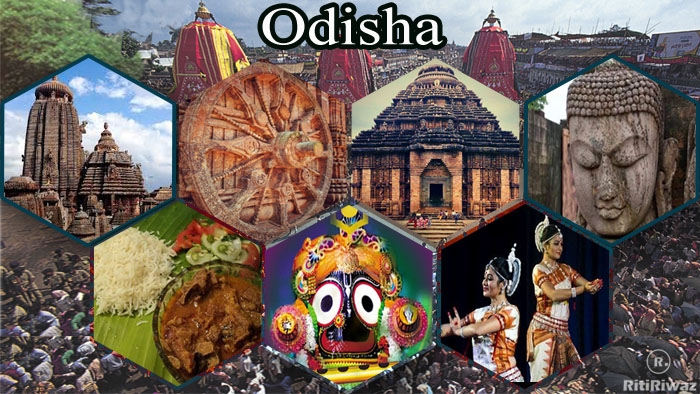
The capital, Bhubaneswar, is well known as the Temple City or EkamraKshetra as it still preserves over 500 of India's most exquisite temples. Similarly, Odisha has many worthwhile heritage sites like the Lingaraj temple, Konark Sun Temple, Dhauli (where the famous Kalinga war took place) and the notable PuriJagannath Temple.
The government's proactive approach in promoting tourism with its unique tagline claiming Odisha to be "India's Best Kept Secret" has brought in people from around the world to witness the peaceful co-existence of many different tribes along with the developed city life.
The tropical wet-dry climate indeed makes it an ideal tourist spot, mostly for nature lovers and people having a keen interest in diverse culture and traditions. Even during the warmest month of May when temperature usually cross 40-degree Celsius, the hilly regions provide relief and hence attract many tourists. Rainfall in the state occurs from June to September. But because of its geographical placement the state also faces the wrath of the concurrent high storm tides and cyclonic storms, resulting in massive destruction, almost every year.
The population composition of Odisha has two-fifths of Scheduled Tribes and Scheduled Castes. Division of tribal people is based on linguistics - Munda languages, speakers of various languages of the Dravidian family and the speakers of Odia. But today Odia, the official language of Odisha, is spoken by many tribal as well as non-tribal population. People speak Bengali in some of the northeastern parts. The dominant religion followed by the people of the state is Hinduism, followed by Islam which makes the largest religious minority. Other prominent religions are Christianity, Buddhism and Jainism. Every Hindu, throughout the country, looks up to Lord Jagannath, of Puri, as a prominentcentre of their religious faith.
Most of the population reside in the rural areas. The farming community densely populates the coastal plains. Most tribals are in the hilly regions.The major cities of the state are Bhubaneswar, Cuttack, Puri and Rourkela.
The eastern state of Odisha is blessed with vast mineral reserves like coal, bauxite, iron ore, limestone etc. that raise the state's worth when it comes to their industrial uses.
The major economic activities in the state are agriculture, mining, energy, manufacturing and services.
Odisha is primarily an agrarian state, and agriculture provides about 70% of employment opportunities. Yet the sector accounts for only 26% (meagre) of the state's GDP. Important crops are rice, pulses, oilseeds, cereals, jute, sugarcane, coconuts and spices. But usually, agricultural families are engaged in agro-based industries or non-agricultural activities since factors like low sunlight availability, modest soil quality etc. result in a low yield.
On the other hand, the eastern state of Odisha has an endowment of vast mineral reserves like coal, bauxite, iron ore, limestone etc. that raise the state's worth when it comes to their industrial uses. The state is one of the top producers of high-quality iron ore. Various industrial groups like the Tatas, Reliance, Jindal, etc., in recent years, have been eyeing Odisha to expand their business which has helped the state receive substantial private investments. The town of Talcher is bestowed with coal reserves which provide a reliable energy base for various large-scale industries.
Similarly, Odisha also generates a considerable amount of electricity through hydroelectric stations by harnessing the great Mahanadi river through the Machkund and Hirakud dam. The Hirakud Dam is the longest and the second largest dam in the world, producing 347.5 MW of power. The dams play a considerable role in checking floods, ensuring irrigation and power supply to the lower basin.
The manufacturing industries present in the state are predominantly large-scale industries tied to natural resources like steel, ferromanganese, cement, aluminium, fertiliser production and non-ferrous smelting. Being one of the most mineral-rich states in India, Odisha accounts for over 55% of the country's bauxite reserves and hence ranks first in the production of aluminium. It is also one of the favoured investment destinations for domestic and international iron and steel players. Recently, the government came up with "Team Odisha" to help with investment promotion. With an attractive combination of ease of doing business along with a low cost of doing business, Odisha is eyeing at corporates. The best example of this is the highly successful 'Make in Odisha' Conclave of 2018.
Odisha also has several MSMEs industries, including mills producing sugar, paper, glassworks etc. There is also a small but well-recognised handicraft sector, with its world-famous textiles, silver filigree so on and so forth.
Odisha's service sector developed in the early 21st century. As per the Odisha Economic Survey of 2018-19, the service sector constituted 41.6% of the Gross State Value Added (GSVA), making it a vital driver of the economy. The services mainly include banking, finance, insurance, trade, hospitality and tourism. Even though the state has vast potential in tourism, it has seen a decline in the growth rate. Only in the last fiscal year, with greater emphasis on tourism by the government, there has been a marginal increase. Also, Odisha has been continually trying to promote sports and became the first state to sponsor the Indian hockey teams with a five-year contract.
The state government has been proactive in conducting various programs to improve and expand its healthcare structure, educational, cultural, economic and welfare opportunities. The literacy rate, according to NSS, is at 77.3%, i.e. 0.4% less than the national average. Odisha has been very efficient at controlling the present COVID-19 crisis through a robust healthcare facility.
Odisha has a rich heritage and an exquisite culture producing some of the most excellent examples of Indian art forms and architecture. In visual arts, it is famous for mural paintings, stone carving, painting on palm leaves, sand art. Odissi and Chhau are some of the well-known dance forms, traditionally performed to depict a mythological story. Lastly, Odisha is also the site for various festivals unique to its soil, like Raja Parba, Boita-Bandana etc.