IPF Webinar on Kashmir after the removal of Article 370
Total Views |
IPF Webinar
on
Kashmir after the removal of Article 370
June 24, 2020
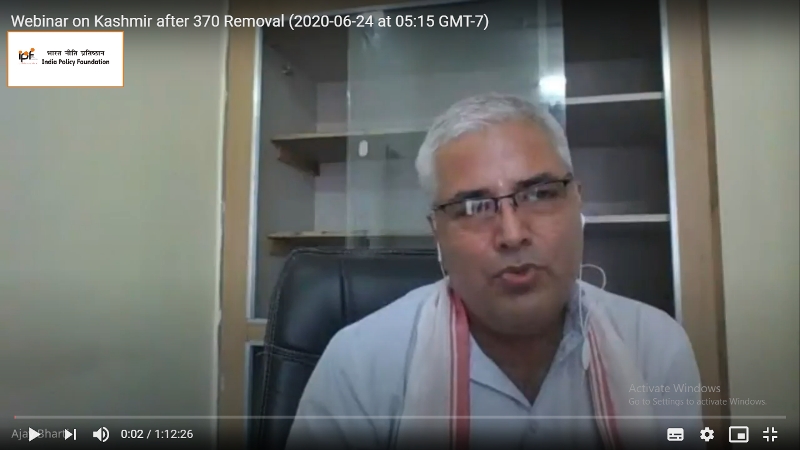
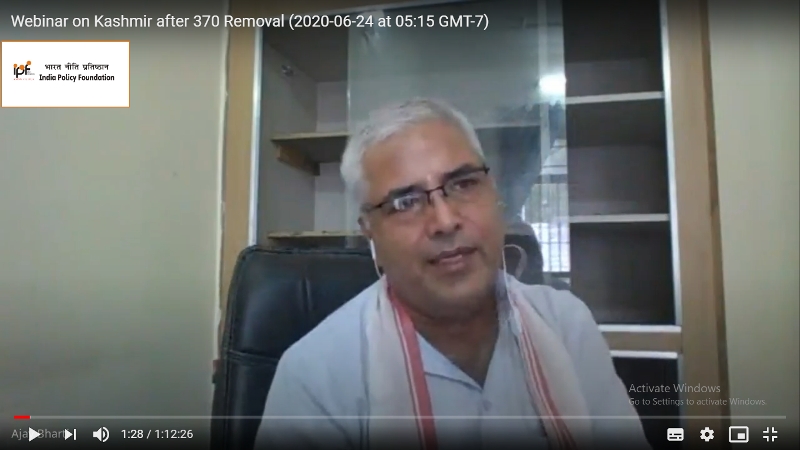
“Jammu and Kashmir’s identity was pen and never weapons,’ said Shri G L Raina, former Member of Legislative Council (MLC), Jammu and Kashmir. He was speaking on ‘Kashmir after removal of Article 370’ during a webinar organized by the India Policy Foundation (IPF). The webinar was moderated by Dr Kuldeep Ratnoo, Director, IPF.
Shri Raina began his lecture by pointing out that much of what has been said about Jammu and Kashmir are stories. He stressed that 2008 was the watershed year for Jammu and Kashmir (J&K) as that was the year the Amarnath agitation was launched by the Bhartiya Janata Party (BJP). The controversy erupted when on 26 May 2008, the Government of India and the state government of J&K reached an agreement to transfer 99 acres of forest land to the Shri Amarnathji Shrine Board (SASB) in the main Kashmir valley to set up temporary shelters and facilities for Hindu pilgrims.
He pointed out that for the first three days it was a normal agitation. It assumed strategic importance only when the government leadership told the nation that they will drive it ahead. He opined that issues like resettlement of pandits and the future of regional parties are only symptoms of the already existing problems.
Going back to history, Shri Raina said for a very long time, the narrative of Kashmir used to revolve around three personalities – Maharaja Hari Singh, Jawaharlal Nehru, and Sheikh Abdullah. This began changing only in 2010-11 when there began a discussion on Article 370. It was Prime Minister Narendra Modi who first told during a rally in 2013 in J&K that Article 370 should be discussed.
In reply to a question by Dr Kuldeep Ratnoo, Shri G. L. Raina pointed out that Article 370 was always discriminatory and was till then seen in the context of religion and secularism. He opined that the discrimination prevalent in J&K due to Article 370 was equivalent to racism in the United States. To further his observation, he pointed to the plight of the Valmiki community in Kashmir who were systematically oppressed using the provisions of Article 370 as well as Article 35 A. They were denied residential rights and faced discrimination in higher education and government jobs. Same is the case with women who used to marry outside J&K. The plight of Pakistan refugees is also similar who despite being in India for many generations are not considered Indian citizens. He also threw light on the widespread corruption and lack of accountability.
He argued that the repealing of Article 370 had removed many of the systemic biases prevalent in J&K. It gave the freedom to people to identify with each region independently and choose their own heroes. While agreeing that the removal of Article 370 was surprising, he said it is necessary to understand the decision in the right context. It is often forgotten that Article 370 was only a temporary provision in the Indian Constitution and it needs to be asked who was benefitting out of it.
He applauded the government for the meticulous planning before the removal of Article 370. Drawing on his experience as MLC, he said majority of the common people had welcomed the decision but did not express it. For many of them, terrorism is still a threat and they understand the importance of this decision. Post the removal of Article 370, terrorism recruitment and infiltration has gone down.
However, he pointed out that there are people who still try to derail the process of peace being restored in J&K. In 2019, Prime Minister Modi had visited Kashmir and inaugurated a number of projects. But later it was found that many of the projects announced were planned on encroached land or private land and the bureaucracy had taken no steps to transfer the earmarked areas to the Government of India.
Another instance was when Shri Raina filed an RTI to get the exact number of the pandits who were murdered. The information was not shared by the state government saying that it can’t be given as he resides in New Delhi.
Talking to Dr Kuldeep Ratnoo, Shri Raina pointed out the fake narrative propagated by the Pakistan-ISI-left liberal nexus on demographic change. He mentioned that out of J&K’s total population a significant numbers are soldiers and government servants who have served in the state for 10-15 years. Yet they cannot own any land and their children do not get any benefits. This situation is set to change as anybody who has worked for 10 years in the state and students who have done their schooling for seven years from the state are now eligible to apply for domicile certificates.
Talking about the way forward, he said the original population of Kashmir will have to be brought back. When it comes to the Line of Control, he said it needs to be understood that it is the people of India who are on the other side of the border too. The nation shouldn’t forget that the attack is happening from the Indian soil.
He lamented that J&K is a resourceless state with 85 per cent of employment generated through government jobs. He reminded everyone of Sharada Peeth in Kashmir and said avenues need to be created for emotional integration. J&K should tap into the unused potential of education, tourism, medicinal plants, and health.
He opined that there is a need to evolve with the changing times. As an example, he said J&K has around 8 and a half lakh differently-abled people. Yet during a social audit, it was found that not a single government building is accessible for the differently-abled population. It is to bring about such constructive steps that governance should be improved and there should be better use of technology. He said there is a need for new leadership to emerge which may take about 10-15 years, but will eventually lead J&K in the right direction.
(Report prepared by Lekshmi Parameswaran. Inputs by Vikrant Tyagi)