IPF Webinar on "The Great Nicobar Project – Objectives, Challenges and Implications”
Total Views |


IPF Webinar on
“The Great Nicobar Project – Objectives, Challenges and Implications”
6 June 2026, New Delhi: The India Policy Foundation (IPF) organised a webinar on "The Great Nicobar Project: Objectives, Challenges and Implications." The key speakers included Justice Shri Adarsh Kumar Goel, Former Judge of the Supreme Court of India and Former Chairperson of the National Green Tribunal and Rear Admiral Girish Kumar Garg (Retd.), Distinguished Fellow at the Strategic Research and Growth Foundation. Shri Rajesh Saxena, Retired Joint Secretary, Headquarters Integrated Defence Staff, Ministry of Defence moderated the discussion.
Dr Kuldeep Ratnoo, Director of the India Policy Foundation, initiated the webinar by welcoming the speakers and introducing the theme of the discussion on the Great Nicobar Project. He outlined the key issues to be examined, including the project's objectives, environmental concerns, observations of the National Green Tribunal, and its strategic, developmental, and economic implications.
Introductory Presentation by Shri Rajesh Saxena
Speaking on the project, Shri Rajesh Saxena described it as a strategic infrastructure decision undertaken by the Government of India with a long-term perspective. He stated that his aim was to present the facts objectively. He began by discussing the geographic location of the Andaman and Nicobar Islands, explaining that they represent the continuous northern extension of the submarine mountain ranges that form Sumatra and the broader Indonesian region. He stated that this geographical positioning provides the islands with a significant strategic advantage. He noted that approximately 25 to 30 per cent of global trade passes through the nearby Malacca Strait, a major maritime route and a critical choke point in international navigation. He further stated that the Great Nicobar Island lies only about 40 nautical miles from the main shipping trade route going through Malacca Strait, enhancing its strategic importance.
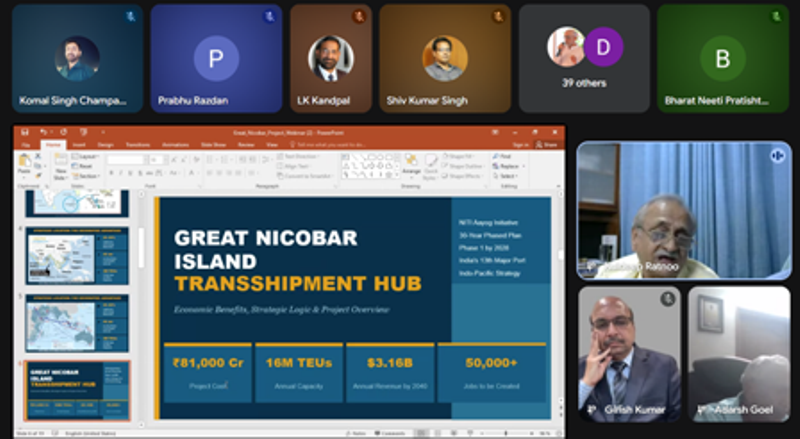
Shri Saxena pointed out that around 3 million TEU (Twenty-foot Equivalent Unit or Container) of Indian cargo is currently handled at foreign ports. In this context, he highlighted the strategic benefits of establishing a transhipment hub at Great Nicobar Island. He stated that the project would create India’s 13th major port and would form an important component of India’s Indo-Pacific strategy.
Discussing the scale of the project, he noted that the estimated cost is ₹81,000 crore. The proposed transhipment hub is expected to have an annual handling capacity of 16 million TEUs. He further stated that the project is expected to generate annual revenue of USD 3.1 billion by 2040 and create more than 50,000 jobs. The total area proposed to be covered under the project is 166.2 square kilometres.
Shri Saxena explained that the project consists of four major components. The first component is the Galathea Bay Port, which is intended to function as a transhipment hub. The second component is an international airport designed for both military and civilian purposes. The third component is a greenfield township that will include residential, commercial, logistics and defence facilities. The fourth component is a hybrid power plant based on gas and solar energy.
He also outlined the implementation timeline of the project. The first phase will run from 2025 to 2035, the second phase from 2036 to 2041, and the third phase from 2042 to 2047.
Explaining the rationale for selecting Great Nicobar Island, he highlighted that the island serves as a critical node in the Indian Ocean Region. He noted that the project is intended to reduce India’s dependence on foreign transhipment hubs and strengthen the country’s maritime and defence presence.
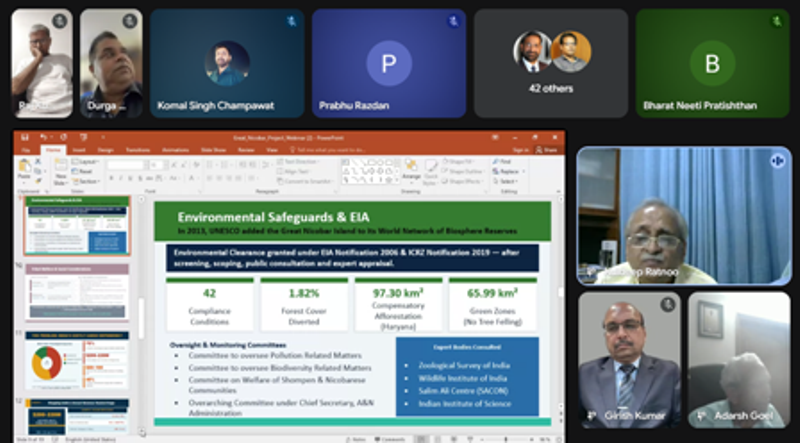
Turning to the regulatory and environmental approval process, Shri Saxena stated that the project was issued an environmental impact notification in 2006. Subsequently, in 2019, a notification was issued under the Coastal Regulation Zone framework. He explained that the project underwent screening, review, public consultation and appraisal processes before receiving approval. He noted that the approval was granted subject to 42 conditions.
Addressing concerns related to forest diversion, he stated that only 1.82 per cent of the forest cover of the Andaman and Nicobar Islands is proposed to be diverted for the project. He further noted that compensatory afforestation covering 97.32 square kilometres has been proposed in Haryana. In addition, he stated that 65.99 square kilometres has been designated as a green zone where no tree felling will take place.
Shri Saxena informed participants that various committees have been established to oversee different aspects of the project. These include committees dealing with pollution, biodiversity conservation, and the welfare of the Shompen and Nicobarese communities. He also referred to an overarching committee functioning under the Chief Secretary and stated that various expert committees have been consulted during the planning and approval process.
He identified tribal welfare and social concerns as major issues associated with the project. In this regard, he referred to government efforts to maintain the isolation of the Jarawa tribe through restrictions on road access to their areas.
Discussing the economic dimension of the project, Shri Saxena stated that India currently loses between USD 200 million and USD 220 million annually in port revenue to foreign transhipment hubs. He further stated that the development of a transhipment hub at Great Nicobar would significantly reduce India's logistics costs by enabling the country to handle a larger share of its cargo through its own port infrastructure. He noted that the current cost of transhipment ranges between USD 80 and USD 100 per TEU and argued that reducing dependence on foreign ports would make Indian exports more globally competitive. He also observed that the island has the potential to be developed as a global tourism destination, creating additional economic opportunities alongside its maritime and strategic functions.
He concluded by outlining the major environmental concerns being raised in relation to the project. These include large-scale forest diversion and threats to endemic species such as the Nicobar megapode and endemic turtles. He noted that the area contains the largest nesting ground for the leatherback turtles and that their survival may be endangered. He added that the additional concerns relate to compliance with coastal zone regulations and the risks associated with tsunamis. Concerns have also been raised regarding the impact of the project on indigenous tribal habitats.
Remarks by Justice Shri Adarsh Kumar Goel
Justice Shri Adarsh Kumar Goel began by making it clear that he was not explaining the judgment of the National Green Tribunal (NGT) but was only presenting his personal views on the matter. He noted that he had the opportunity to review the Great Nicobar Project on 3 April 2023.

He explained the legal framework governing environmental clearances and appeals in India. Referring to Section 16 of the National Green Tribunal Act, he stated that any environmental or forest clearance granted by any authority in the country, including the Central Government, can be challenged through an appeal before the NGT. He further referred to Section 20 of the NGT Act, which requires the Tribunal to be guided by three principles: sustainable development, the precautionary principle, and the polluter pays principle.
Justice Goel discussed the environmental regulatory framework in India, referring to the notification issued under Section 3 of the Environment Protection Act on 14 September 2006. He described it as a detailed notification laying down the procedure for environmental clearance and observed that the environmental clearance mechanism is intended to implement the precautionary principle. He emphasized that environmental protection forms part of the right to life under the Indian Constitution.
Tracing the evolution of environmental law in India, he noted that the global environmental movement received momentum following the Stockholm Conference of 5 June 1972. To give effect to its objectives, India enacted the Water (Prevention and Control of Pollution) Act in 1974, under which Pollution Control Boards were established at the central and state levels. He stated that the Wildlife Protection Act came into force in 1972 and that the Air (Prevention and Control of Pollution) Act was enacted in 1984. Following the Bhopal Gas Tragedy, the Environment Protection Act was enacted in 1986 as an umbrella legislation for environmental governance. He also referred to the Forest Conservation Act of 1980, which mandates that no non-forest activity can be undertaken in forest areas without the permission of the Central Government. He noted that in 1996 the Supreme Court expanded the meaning of forests by holding that anything that qualifies as a forest in the dictionary sense can be treated as a forest irrespective of whether it is formally recorded as such or not.
Justice Goel explained that environmental impact assessment is followed by environmental clearance and that an Environment Management Plan is prepared to mitigate adverse environmental effects. He referred to the process of Cost-Benefit Analysis (CBA), under which a comprehensive chart is prepared and appraised by the Environmental Appraisal Committee. He stated that the committee comprises experts from various sectors. Thereafter, affected persons are heard through a public hearing process. The assessment is conducted by specialised agencies on the basis of prescribed terms of reference. The Environment Management Plan is then prepared to address and mitigate adverse environmental impacts.
He also referred to a jurisprudential debate within environmental law regarding whether elements of nature such as trees and rivers should be treated as legal persons because they too are affected by human actions. He observed that an Environment Management Plan assesses the impact of projects on affected areas and examines the consequences of locating projects in particular locations. He further stated that nature belongs to the people and is not the property of the State, which acts merely as a trustee.
Providing background on the Andaman and Nicobar Islands, Justice Goel stated that Nicobar covers an area of 910 kilometres and occupies a strategic location. He noted that it shares international maritime proximity with Myanmar, Thailand and Indonesia and that Singapore is also situated nearby. He stated that the Andaman and Nicobar archipelago consists of 836 islands, of which only 31 are inhabited. The Andaman and Nicobar groups are separated by the 150-kilometre-wide Ten Degree Channel. He noted that the islands are approximately 710 kilometres from Kolkata and around 1,000 kilometres from Chennai.
Justice Goel also discussed the historical significance of the islands. He stated that they served as a naval base for the Chola Kings of Tamil Nadu. Subsequently, Dutch traders came to the islands for business purposes, and in 1866 the British acquired the islands from the Dutch. The British established the Cellular Jail, which became functional in 1906. During the Second World War, Japan occupied the islands from 1942 to 1945 before surrendering them back to the British. He remarked that the islands possess a broad and significant history.
Referring to the 2004 tsunami, he stated that approximately 2,000 people lost their lives and 40,000 people were displaced. He highlighted the ecological richness of the islands, noting their flora and fauna, mangroves, diverse tree species and wildlife. He stated that the total population of the islands is around four lakh. According to him, after the 2004 tsunami, the Government of India began considering the development of the region.
Justice Goel noted that the Great Nicobar Project was developed by NITI Aayog at a projected cost of ₹81,000 crore and described it as a mega island development project. He stated that its largest component is the International Container Transhipment Terminal. He observed that if India does not establish a port near the Malacca Strait, China may develop similar facilities in nearby areas. He remarked that development itself is a form of environmental protection and respect for the environment is regarded as something divine.
Discussing the economic rationale, he stated that the Government of India plans to invest ₹81,000 crore over a period of 31 years and expects revenue of ₹31,00 crore. He observed that the project possesses substantial defence significance and that such strategic considerations receive significant weightage in the Cost-Benefit Analysis process.
Justice Goel then addressed the principal environmental concerns associated with the project. He stated that approximately 9.64 lakh trees would be affected, describing this as a very significant number. He pointed out that the National Forest Policy does not permit the felling of trees merely because they constitute a resource but allows it where there is absolute necessary. At the same time, the policy requires that India’s forest cover should not fall below one-third of the country’s total geographical area. He observed that the country is already below that benchmark and that continued efforts are necessary to increase tree cover in order to ensure sufficient oxygen for sustaining the population.
He noted that nearly ten lakh trees are proposed to be cut and that the Government of India justifies this through the Cost-Benefit Analysis process by pointing out that forest cover in the Andaman and Nicobar Islands remains very high, with approximately 70 to 80 per cent of the islands still under forest cover. According to him, the project cannot be implemented without cutting trees. However, he stated that it is possible to choose the nature of trees that are removed and to save others. He stressed that while one aspect is incorporating safeguards into project approvals, an equally important aspect is ensuring that those safeguards are actually implemented.
Justice Goel referred to the role of the National Centre for Sustainable Coastal Management, functioning under the Ministry of Environment, which has prepared maps relating to the project area. He observed that coral reefs are present in significant numbers in the area proposed for the transhipment hub. He also stated that within a radius of ten kilometres there are endemic species and rare wildlife species and that any human or infrastructure activity poses a threat to them.
He further noted that 1,761 individuals belonging to Particularly Vulnerable Tribal Groups reside in the region and require special environmental conditions and protections. He observed that the area contains biodiversity hotspots and stated that Great Nicobar forms part of a UNESCO World Heritage Site. He added that the island hosts around 200 bird species and that Galathea Bay is a Ramsar wetland. Raising concerns regarding environmental impacts, he questioned how wildlife could be protected if dredging of the seabed takes place. He observed that coral reefs support hundreds of fish species and warned that damage to them could disrupt the marine food chain. He further noted that mangroves act as natural barriers against tsunamis and that their destruction would increase coastal vulnerability.
According to Justice Goel, these constitute the principal challenges confronting environment conservationists. He also pointed out that the island falls within a seismic zone.

Despite these concerns and challenges, Justice Goel stated that both the Government and the National Green Tribunal granted approval to the project because of the safeguards that had been incorporated. He noted that high-powered committees had been constituted to meet periodically, monitor implementation, conduct site visits and engage with environmental and tribal experts. He stated that reassessments would be undertaken through multi-season biodiversity studies and that existing data would be subjected to further review. He added that seismic standards would be imposed and that a special wildlife management plan had been prepared.
He further noted that the Zoological Survey of India had prepared a coral conservation plan and that a mangrove conservation plan had also been developed. According to him, plans existed to address all major concerns. In cases where plans were not already in place, the NGT granted conditional approval in the larger national interest. He stated that a high-powered monitoring committee continues to oversee the project. Concluding his remarks, he observed that every environmental violation gives rise to a fresh cause of action that can be challenged before the appropriate forum.
Remarks by Rear Admiral Girish Kumar Garg (Retd.)
Rear Admiral Girish Kumar Garg stated at the outset that his presentation would focus on the strategic aspects of the Great Nicobar Project. He began by emphasising the importance of the Malacca Strait, noting that a substantial portion of the maritime traffic of China, Japan and East Asia passes through this route. According to him, if the Malacca Strait were to be blocked, the maritime trade of East Asia would be severely disrupted. He observed that China is acutely aware of this vulnerability and has been actively debating the issue since 2002. In his view, initiatives such as China’s String of Pearls strategy and the Belt and Road Initiative (BRI) are, in part, responses to this strategic concern.
Rear Admiral Garg pointed out that Great Nicobar Island lies only about 350 kilometres from the Malacca Strait. He argued that India is presently not adequately equipped to respond quickly to any attack on the Strait or on the Andaman and Nicobar Islands. In such a situation, India would have to depend on naval bases located on the mainland, such as Visakhapatnam, Mumbai and Chennai. Even at maximum speed, he noted, naval vessels would require approximately three days to reach the area.
He further explained that the Six Degree Channel is located only about 40 nautical miles from Great Nicobar Island. Under international law, all ships, including merchant vessels and warships, are permitted to pass through this channel. The Ten Degree Channel passes through the Andaman and Nicobar Islands. According to Rear Admiral Garg, an enemy vessel could potentially enter through the Six Degree Channel, alter its course and raise its flag on one of the many uninhabited islands in the region. He argued that India is currently not in a position to launch an immediate response to such a development and that it could take almost three days before Indian forces are able to react effectively.
He noted that the only naval base presently located in the Andaman and Nicobar Islands is at Port Blair. It is a relatively small facility and cannot accommodate large naval vessels. He argued that India requires a base from which large ships and aircraft carriers can operate. In this context, he highlighted the significance of Great Nicobar Island, where the natural depth is approximately 20 metres. This depth, he stated, is sufficient to accommodate large merchant vessels and aircraft carriers. At present, he observed, India’s aircraft carriers cannot enter the existing harbour facilities in the region. He therefore argued that the Great Nicobar Project is important from the standpoint of strategic security.
Rear Admiral Garg also referred to the increasing military presence in the Indian Ocean, stating that more than fifty warships belonging to different countries are currently operating in the region for various stated reasons. In this geopolitical environment, he argued that India faces significant risks. He observed that in international relations, today’s friend may become tomorrow’s adversary and remarked that geopolitics is governed not by permanent friendships but by permanent interests.
Discussing the proposed airport at Great Nicobar, he noted that it is being designed as a dual-use facility serving both military and civilian purposes. According to him, the airport will initially have a runway of 3,000 metres, which will later be extended to 4,000 metres. Such a facility, he stated, would be capable of handling India’s largest aircraft. He therefore argued that this aspect of the project further strengthens the case for supporting it.
From a strategic perspective, Rear Admiral Garg observed that the current population of Great Nicobar Island is approximately 10,000 and that very little infrastructure exists there at present. He stressed the importance of creating a support system and developing infrastructure in the area. According to him, the region should be capable of supporting a full-fledged military ecosystem, which he regarded as essential for India’s national security.
Turning to environmental concerns, he stated that 50 per cent of the project area has already been declared a green area by the Government. He noted that the remaining area contains approximately 18 lakh trees. However, he pointed out that the project will be implemented over a period of nearly 25 years and that the total number of trees proposed to be cut is around 7.5 lakh. He emphasised that compensatory afforestation is mandatory under Indian law and stated that trees will be planted over an area of 97 square kilometres in Haryana. He further noted that 2.4 lakh trees have already been planted under the “Ek Ped Maa Ke Naam” initiative even before any trees have been cut for the project. According to him, once the infrastructure is completed, extensive landscaping will be undertaken in Great Nicobar, resulting in the planting of an additional one to one-and-a-half lakh trees.
Addressing concerns regarding tribal communities, Rear Admiral Garg argued that the project area of 166 square kilometres is located near the coast and does not interfere with tribal habitats. He stated that out of the total area of 910 square kilometres in the Andaman and Nicobar Islands, 751 square kilometres have been designated as tribal reserves. He referred to Shompen and Nicobarese tribal areas, citing figures of 237 and 1,094 respectively, bringing the total to 1,331. According to him, both the core areas and buffer zones of these reserves are extensive and remain largely untouched. He stated that only 74 square kilometres of the project area touches the buffer zone. This area, he explained, was denotified but another 78 square kilometres was renotified, resulting in a net increase of four square kilometres in the protected area.
He further noted that the Expert Appraisal Committee comprises fifteen members, most of whom are subject matter experts. The Committee has specifically stated that geo-fencing will be established around tribal areas to ensure their protection. On this basis, he expressed the view that the project would not adversely affect tribal communities.
Rear Admiral Garg also addressed concerns relating to leatherback turtles in Galathea Bay. He stated that there are twenty-three nesting grounds for leatherback turtles across the Andaman and Nicobar Islands. Referring to the environmental clearance granted for the project, he noted that no construction is permitted within 500 metres of the high-tide line in order to protect turtle habitats. He stated that the nesting grounds are located on the left side of Galathea Bay, while the proposed development is situated on the right side. He further noted that the environmental clearance explicitly prohibits development on the western side of the bay. The clearance also requires that leatherback turtles be geo-tagged and their movement monitored by the Wildlife Institute of India. Additional mitigation measures, he stated, would be implemented if the existing measures prove insufficient.
On the issue of tsunamis, Rear Admiral Garg recalled that Great Nicobar Island had subsided by approximately four metres during the 2004 tsunami. Consequently, he stated that all infrastructure proposed under the project is being designed to withstand tsunami events and comply with seismic zone V standards. According to him, all project contracts specify that construction must conform to the requirements applicable to seismic zone V. He pointed to Japan as an example of a country that has successfully developed a thriving economy in a highly seismic region and argued that similar development can be achieved on a smaller scale in Great Nicobar.
Explaining further why Great Nicobar Island was selected for the project, he highlighted its natural harbour depth of approximately 20 metres, which is suitable for large ships. According to him, this eliminates the need for extensive excavation and thereby reduces project costs. He also stated that siltation levels in Great Nicobar are almost negligible, reducing the need for dredging and lowering long-term maintenance costs.
In conclusion, Rear Admiral Garg argued that completion of the proposed infrastructure would place India in a commanding position across the Indo-Pacific region and provide substantial strategic leverage. He emphasised the need to conduct a cost-benefit analysis that balances environmental concerns against national interests. Referring to the example of Singapore, he argued that the advantages of the project significantly outweigh its disadvantages. He concluded by describing the Great Nicobar Project as an initiative of great national significance that has the potential to redefine India’s position in the Indo-Pacific region.
Question and Answer Session
During the question-and-answer session, participants raised a number of concerns and observations relating to the Great Nicobar Project. Questions were asked regarding the government's approach towards Particularly Vulnerable Tribal Groups and whether efforts were being made to bring them into the mainstream. Concerns were also expressed about the feasibility of coral reef relocation, with participants observing that coral transplantation is a difficult process and that the Government needs to devote greater attention to this issue. Another participant stated that the commercial component of the project was a matter of concern and suggested that exemptions should be restricted to those aspects directly linked to national security. Questions were also raised regarding the manner in which political opposition to the project was being addressed. One participant asked whether Great Nicobar could be utilised for aeronautics and drone testing, given India's limited airspace for such activities. Another participant observed that a negative narrative had developed around the project and remarked that, after hearing the discussion, the public no longer believed many of the criticisms to be accurate. The participant added that the facts about the project had not yet reached the wider public.
Responding to the concerns regarding tribal communities, Justice Adarsh Kumar Goel stated that it has consistently been the policy of the Government of India to protect the natural habitat of the Shompen community and leave them largely untouched. Shri Rajesh Saxena added that these communities do not possess the immunity required to withstand extensive contact with outsiders. He referred to earlier efforts by the Government to bring the Jarawa community into the mainstream and stated that such efforts had not succeeded because their bodies were unable to withstand outside contact.
Addressing concerns about coral relocation, Justice Goel stated that the Wildlife Institute of India and the Botanical Survey of India had undertaken detailed studies on methods for relocating coral reefs. He noted that the process would take time and would begin with a pilot phase followed by in-depth studies. According to him, the project is expected to evolve over the years into a successful coral relocation initiative. He further observed that a dedicated coral conservation plan had been prepared specifically for the project.
In response to questions regarding strategic infrastructure, it was stated that INS Baaz could not be expanded because doing so would involve greater environmental costs as well as other strategic considerations. The speakers emphasised that their objective was to place facts before the public, leaving individuals to form their own conclusions.
Responding to the query on aeronautics and drone testing, it was noted that the proposed airport includes a substantial area earmarked for defence-related activities. It was further stated that a significant area under defence control has been reserved for future development and could potentially support activities such as drone testing.
Justice Goel remarked that, in broad terms, the project had been considered necessary for the country and stated that this was also the view taken by the National Green Tribunal. Shri Saxena added that similar concerns had been raised during the construction of projects such as the Panama Canal and the development of Singapore. He argued that those bold decisions had subsequently yielded significant benefits. In his view, the Great Nicobar Project represents an example of sustainable development and should not be viewed as a choice between environmental protection and development. He concluded by stating that course correction remains possible because the project is being implemented over a long period of time.
Concluding Remarks by Dr Kuldeep Ratnoo
In his concluding remarks, Dr Kuldeep Ratnoo reflected on the broader debate between development and environmental conservation. He observed that this debate has existed since the earliest stages of human civilisation. Whether it was early humans hunting animals and birds for food, cutting trees to build homes, clearing land for agriculture, or making use of natural resources for survival, the question of balancing human needs with the natural environment has always been present.
Dr Ratnoo noted that the environment itself has witnessed dramatic changes over time, including ice ages, floods and other extreme events. He pointed out that such changes occurred even when human populations were much smaller, suggesting that nature has its own processes and dynamics. Referring to geological history, he remarked that Peninsular India was once part of a vast landmass from which regions such as Africa separated and during whose evolution the Himalayas were formed. He also observed that climatic conditions have varied throughout history, with periods of higher and lower temperatures and recurring floods. Referring to India's civilisational history, he noted that the Saraswati River eventually dried up and that cultural reverence shifted towards rivers such as the Ganga and Yamuna.
Dr Ratnoo argued that human understanding and vision are limited when compared to the scale and complexity of natural processes. At the same time, he acknowledged that human beings continuously alter and affect the environment. He pointed to what he described as a contradiction in public discourse, where large development projects such as dams built in the post-independence period are often praised, while contemporary development initiatives are sometimes opposed on environmental grounds. He observed that political actors who criticise development projects today often overlook the fact that they too prioritised development when they were in positions of power.
Dr Ratnoo emphasized that environmental protection should be regarded as a responsibility of all human beings. He stated that Indian civilisational traditions have long treated nature as sacred and worthy of worship. Referring to the Vedas, he noted that many deities represent natural forces and elements, reflecting a deep cultural respect for nature. He concluded by stating that decisions relating to development and environmental protection should ultimately be guided by careful cost-benefit analysis that takes into account both short-term and long-term considerations.