An Eclipsed Glory: Deciphering Kashmir’s lost legacy
02 Nov 2020 10:58:00
An Eclipsed Glory: Deciphering Kashmir’s lost legacy
By Ganesh Puthur
November 2, 2020
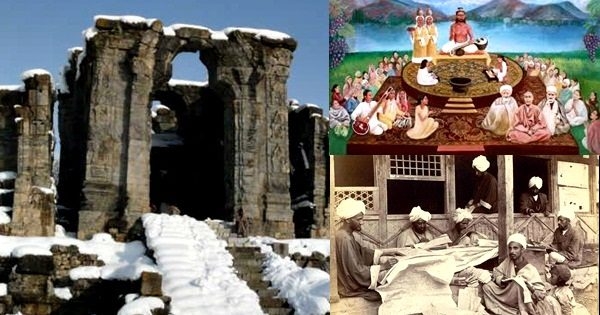
Kashmir was once renowned for its cultural heritage and a vibrant knowledge system. But multiple invasions and the subsequent reigns of Islamic attackers reduced the land of great ‘spiritual practices’ into a graveyard of Indic antiquity. Systematic efforts were made to cut Kashmir from its roots, and a completely alien culture was presented as indigenous through distortion of history by vested interests to push the separatist agenda. But what lies beneath the Chinar leaves is the tale of Kashmir’s dynamic past,purposely ignored by academicians with anti-India leanings.
There is a deliberate lie spread by western scholars that Indians lack any sense of their history. This lie is exposed by the fact thatRajatarangini, a 12th-century book written by Kalhanaprovides 5000-year-long history of Kashmir. The book shares valuable information regarding Kashmir’s successive dynasties, sacred places, geography and its economy. Kalhana had relied upon his preceding historical sources including NilamataPurana (6th to 8th century), Nripavali and Parthivavali to depict Kashmir’s political and cultural transition. What we understand from these illustrious sources is the existence of a well defined socio-cultural structure in ancient Kashmir and a disruption to it since beginning of Shah Miri dynasty in the 14th century.
Kashmir’s original culture has been a continuation of Indian Vedic Traditions includingShaivism. The name Kashmir itself comes from Rishi Kashyapa, who was one among the Sapthrishis. Later, Buddhism entered Kashmir through state patronage. Rajatarangini mentions that during the rule of Ashoka, a large number of Buddhist stupas were erected in Kashmir.But he also constructed Hindu temples dedicated to Lord Shiva. Later these temples were renovated byRaddadevi, the queen of King Jayasimha(Pandit, 1935). Ashoka had invited Buddhist monks from Kashmir to attend the Third Buddhist council held at Pataliputra (present day Patna). Also, the fourth Buddhist council was held at Kundalavananear Kashmir in the first century CE under the patronage of Kushana ruler Kanishka and supervision of Vasumithra and Asvaghosa. NilamataPurana, which gives details about Kashmir’s cultural past mentioned Buddha as an incarnation of Lord Vishnu(Warikoo, 2009). The co-existence of these two Indic religions flourished in the region for centuries.
Shaivism emerged as a dominant spiritual path at the beginning of the fifth century CE in Kashmir. Tryambkaditya is considered as the first preacher of the Kashmiri school of Shaivism. This school of thought considers Shiva as the supreme reality and connects an individual’s inner self to that universal soul. Its resemblance with Advaitha Vedanta cannot be ignored. Bhakti movement was at its peak in 12th-13th centuries, hence Hindu teachings influenced Muslims, and Sufism was a by-product of that influence(Dhar, 2009). Advaitha forms the very base of Sufism in Kashmir. It is this connection with Indian philosophy that makes Sufis heretics in the eyes of radical Muslims. Sheikh Noor-ud-Din Noorani, also known as Nund Rishi was a Kashmiri Sufi saint. He was spiritually inspired by Shaivite mystic Lalleshwari, the pioneer of Bhakti movement in Kashmir.
Sharada Peeth, presently located in the Pakistan Occupied Kashmir, 10-Kms from the Line of Control, was an ancient temple cum knowledge centre(Rehman, 2017). ‘SarvajnaPeetham’ was a test at SharadaPeeth which only a learned person could pass. The temple was dedicated to goddess Saraswati, the Hindu goddess of knowledge.AdiShankara, a young philosopher saint from Kerala reached Kashmir, debated with Pandits and other learned men to attain SarvajnaPeetham.Such was the thirst for knowledge in the entire Indian sub-continent. But a few centuries later, our universities and libraries were burnt down by the Islamic attackers.
Many great literary works in Sanskrit were produced from Kashmir. It included books on poetry, phonetics, grammar, medicine and philosophy. All the six schools of Sanskrit poetry Alamkara, Riti, Rasa, Dhvani, Vakrokti and Aucityahad its origin in Kashmir (Ghai, 2009). Commentaries on Panini’s Astasdhyayi and Patanjali’sMahabhasya were also composed there. Samyamatrika written by Kshemendra gives details about Kashmir’s topography.Somadeva, who wrote Kadhasaritsagar mentioned some of the holy places like Varahkshethra, Nandikshethra, Uttarmanasa and the down of Hiranypura(Kalla D. B., 2012). The genre of Kashmiri writers ranged from the dramas of Kalidasa(Kalla L. D., 1926) to the love poems of Bilhana to the Shiva Sutras of Vasugupta.These Sanskrit textbooks are not just great literary pieces but also provide us with enormous information regarding the culture, history, topography, geography and social life of Kashmir.
Kashmir was home to magnificent temple structures prior to the beginning of Muslim rule. Sikandar Shah Miri, also known as the SikandarButshikan (the iconoclast) destroyed iconic temples including Martand Sun Temple, Bahrane Mahadeva temple, and temples of Chakradhara, Sureshwara and Tripureshwara. Hindus were selectively targeted, converted and those who refused to convert were killed. Jizya was imposed on non-Muslims and Syed Ali Shah Hamadani was brought in to convert Brahmins to Islam (Tikoo, 2012). The medieval rulers of Kashmir like their Delhi Sultanate counterparts and Mughalswere intolerant and brutal towards non-Muslim subjects and their places of worship.
What is being exhibited today as ‘Kashmiriyat’ is the pseudo imagery of non-Kashmiri beliefs. Anything connected to Kashmir’s Hindu past is mutilated and presented in a much different form. Thousands of villages in Kashmir that bore Hindu names were given Islamic names during the rule of National Conference government led by Sheikh Abdullah. Islamic fundamentalists forced Kashmiri Pandits to exit the Kashmir valley in the 1990s. Hindu Temples were destroyed and Hindu scholars of the valley were targeted. To push separatist agenda,Islamists and their leftist apologistscreated propaganda of “Hindu India subjugating Muslim Kashmir”, a totally bogus claim considering real culture and history of Kashmir. Kashmir is a living example of an indigenous faith replaced by an aggressive-religious framework. A revival of Kashmir’s ancient culture could end the radicalisation and ongoing fundamentalist menace in the Kashmir valley. The land of Kashyapa shall reclaim its lost glory only when the knowledge and understanding about Kashmir and its great spiritual heritage spread among people.
Bibliography
Dhar, T. (2009). Influence of Advaita on Muslim Rishis of Kashmir. In K. Warikoo,
The Cultural Heritage of Jammu and Kashmir (p. 101). New Delhi: Pentagon Press.
Ghai, V. K. (2009). Kashmir: The Land of Sanskrit Poetry and Poetics. In K. Warikoo, The culture and heritage of Kashmir (p. 71). New Delhi: Pentagon Press.
Kalla, D. B. (2012). Koshur Samachar. Retrieved from koausa:
http://www.koausa.org/KoshSam/SanskritLiterature.html
Kalla, L. D. (1926). The Birthplace of Kalidasa. Delhi: Imperial book depot press.
Pandit, R. S. (1935). River of Kings (Rajatarangini). Allahabad: The Indian Press.
Rehman, F. u. (2017). Peace & Economy beyond Faith: A Case Study of Sharda. Pakistan Vision.
Tikoo, C. T. (2012). Kashmir: Its Aborigines and their Exodus. New Delhi: Lancer InterConsult.
Warikoo, K. (2009). Buddhist Heritage of Kashmir. In A. Kaul, Cultural heritage of Jammu and Kashmir (p. 324).
New Delhi: Pentagon Press.
(The writer holds a masters degree in History from the Department of History, University of Hyderabad.)