IPF Webinar on "Has India been a victim of obsession with pacifism?"
18 Jul 2020 15:11:00
IPF Webinar
on
"Has India been a victim of obsession with pacifism?"
July 18, 2020
Address by:
Shri Uday Mahurkar
Senior Journalist, Author and Nationalist Thinker
Moderated by:
Dr Kuldeep Ratnoo
Director, India Policy Foundation
Dr Kuldeep Ratnoo
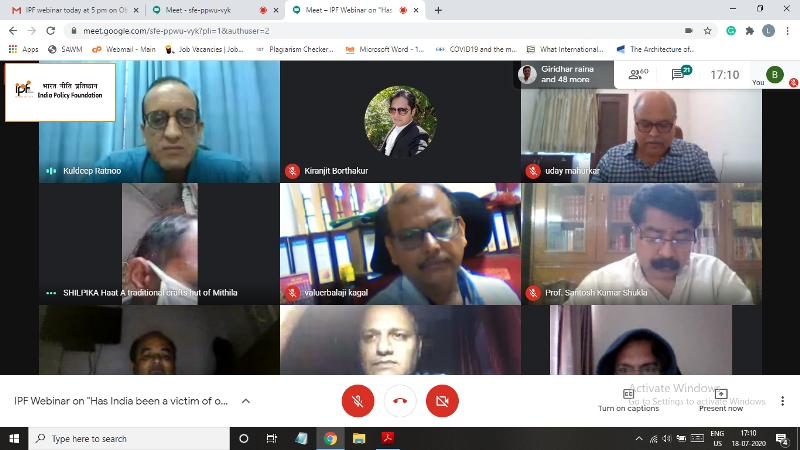
Namaskar! I welcome you all to today’s webinar on “Has India been a victim of obsession with pacifism?” The main speaker for today’s webinar Shri Uday Mahurkar has joined us just now. Shri Uday Mahurkar is a senior journalist, writer, national thinker, and I would say, an intellectual warrior. He comes from a family of Maratha warriors, but he has fought intellectual battles with passion, confidence and courage. He has been raising issues through his writings and speeches which our intellectual class generally avoids talking about.
Shri Uday Mahurkar has been associated with India Today media group for a long time. Currently he is Deputy Editor of India Today magazine and is a renowned political commentator and analyst. He has written few books also. One of these, “Marching with a Billion”, which he wrote in 2017 on Prime Minister Narendra Modi’s governance model, has been in wide discussion.
Shri Mahurkar has been writing and speaking frequently on Veer Savarkar, his ideas, including on Hindutva. Recently, he has also researched and written about empire of Chhatrapati Shivaji and brought out new facts.
Our topic today is our obsession with pacifism. There is a long history behind it in our civilisation, but post-independence, somewhere we got too much carried away by Gandhian pacifism and did not pay enough attention to our national security in a manner which was required. Today we haveUdayMahurkarji to speak to us on this and I request him to kindly address us, and guide us.
Shri Uday Mahurkar
Thank you, Kuldeepji for inviting me to this webinar to speak on such an important topic.
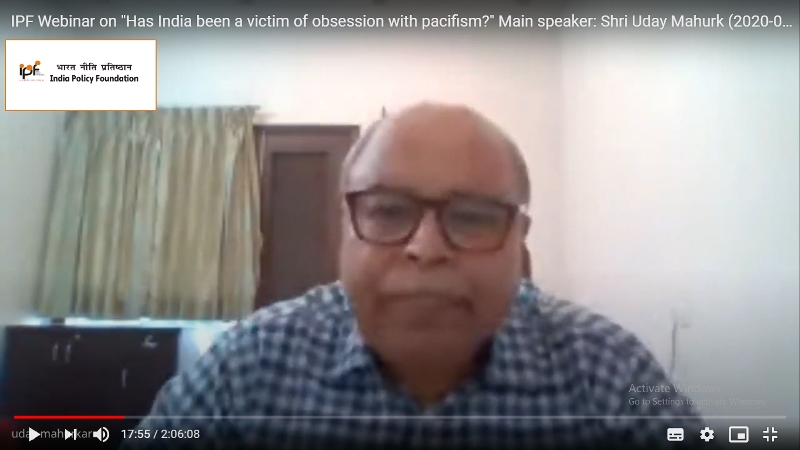
A few days ago, I had put up a note on social media titled “Resetting India’s national security vision” where I argued that in view of the increasing tensions with China and Pakistan, it is necessary to revisit the doctrines of Savarkar and Subash Chandra Bose and start a debate at the national level on these. We need to adopt these doctrines in our national security.
We can very well accept that Mahatma Gandhi had done a lot for the nation. But at the same time, we also need to accept that there are issues –poornaahimsa or complete non-violence and the Hindu-Muslim unity model which I would term as Hindu-Muslim unity at the cost of Hindus have done a lot of harm to the nation.
Due to this pacifism that has been imbibed in us, we are unable to deal with countries like China and Pakistan in the right manner and even after a nationalist government is in power, we have been unable to completely break free from these pacifist ideologies. The time has come to openly adopt the doctrines of Veer Savarkar and Subash Chandra Bose.
A few other points I have made in this note. If America can enter Pakistan’s Territory and kill Osama Bin Laden, then we can also kill the likes of Hafiz Saeed and Masood Azhar.
Another instance that I have pointed out is the conversation between British prime minister Clement Atlee and the chief justice of Calcutta High Court P. B. Chakraborthy, who was acting Governor of the state at that time. Justice Chakraborthy had asked Atlee whydid Britain give freedom to India when the 1942 Quit India movement had failed to make any major impact. To this, Atlee replied that it was Subash Chandra Bose’s Indian National Army (Azad Hind Fauj) that had for the first-time instilled fear in the British government. Atlee made it clear that Britain was able to rule India for so long because it had the support of the Indian soldiers and when they saw that even the soldiers who had fought in the Second World War started demanding independence, they started giving it a serious thought. In addition, to this the Royal Indian Navy mutiny of 1946 was another indication that the time had come for Britishers to exit India. Chakraborthy further asked Atlee about the role of Congress and Mahatma Gandhi in freedom of India to which the latter twisted his lips and said “minimal”.
So, it is clear that we need to revisit history to understand India’s obsession with pacifism. For this, we have to begin from the Lucknow Pact 1916 where we gave a number within the legislature to the Muslims at the cost of Hindu rights. After this comes the compromise that Gandhi had made during the Khilafat movement that remains at the root of the separatist movement in India.It is in this context that the role of Savarkar becomes important. After he was released from prison in 1936, he had got several invitations to join the Congress including one from Subash Chandra Bose. To this, he replied that Congress’s notion that we cannot gain independence without Hindu-Muslim unity is a mistake and will harm the nation in the long run because Muslim leaders will use this to rob Hindus of their rights. He issued a statement in this regard where he said he would like to stand last among the patriots than stand in the front with those who betray the nation.
When the Muslim League Resolution was passed in 1940, Savarkar repeated his thoughts with further clarity. He said it will be impossible for Congress to turn back from the path of Muslim appeasement. The end result of this strategy will be partition. At that time, leader like Nehru and Gandhi had said that the birth of Pakistan will be on their dead bodies. After seven years, it was Savarkar who was proved right.
After partition Savarkar had said that as long as India has a fundamentalist nation as its neighbour, the country will not be able to sleep in peace. Another instance that needs to be noted is when India was offered a permanent seat in the United Nations Security Council in 1956 and it refused that and gave it to China. During the same year, Nehru came up with the Panchsheel doctrine to be followed by India and its neighbours to create a feeling of brotherhood. Here also, Savarkar was the first person who warned that after seeing what China did with Tibet, the idea of Panchsheel will pose a direct threat to India. Guru Golwalkar had also echoed similar sentiments that said that China would try to swallow India’s land. This also proved true after eight years.
After Nehru’s death came Lal Bahadur Shastri. The obsession with pacifism became clear during his term also especially in the 1965 war. We were influenced by the super powers and we gave back all to Pakistanthat we had rightfully won. After Indira Gandhi came to power and when India defeated Pakistan in the 1971 war, it was felt that India was finally forgoing its policy of pacifism. But it did not happen as Indira Gandhi could not solve theKashmir issue even with nearly one lakh prisoners of war and signed the Shimla Agreement. In fact, India handed over the prisoners of war to Pakistan without anything in return. So, it is clear that the reflections of Gandhian pacifism are there everywhere.
Then comes the Kargil war. In 2003, Prime Minister Vajpayee went to China and struck a deal that India recognizes Tibet as a Chinese province and China recognizes Sikkim as an Indian province. But even to this date, Chinese intrusions in Sikkim have not stopped. The pattern has always been that our soldiers conquer land at the cost of their lives but India eventually gives them back to Pakistan and China. After Modi government came to power, we have definitely given a fitting reply through surgical strikes. But on the whole, we have failed to impose a price on China as is evidenced by the rising trade between both the nations.
Why did ShaheenBagh happen? It happened because BJP had initially won Assam, it won Uttar Pradesh, revoked Article 370 and then the Ayodhya verdict came. After this, a conspiracy was hatched by the pan Islamists to create unrest in the country. Their aim is very clear that they want India to be an Islamic nation. In 2001, a book named Demography of India authored by J D Bajaj and Sreenivasan had come out. The foreword was written by L K Advaniji. In it, the authors had argued that if the population growth follows the same trend in the coming years, India will become a Muslim majority nation by 2062. How do we tackle this?
Again, coming to Savarkar, he had predicted the ongoing crisis in Assam in 1940 itself. He had said that the Muslims settling along the Brahmaputra valley will change the demographics of that region and will also pose a security risk to India’s eastern borders. But Nehru had countered this saying we cannot stop anybody from occupying an empty space. To this Savarkar replied that nature also aborts poisonous gas. In 1940 the percentage of Muslims in Assam was only 10-12 per cent. Now it is 35 per cent. Moreover, when the Muslims first came to Assam, they were moderate but now with constant preaching, a good percentage of them have become radicalized.
I would like to share a personal experience with you. What are the views of the radical Islamists? I got an answer in 2006. I have been following a person named S Q Illyas from 2003. He is the father of Umar Khalid who is now identified with the tukde-tukde gang.Illyas was the president of SIMI. During 2003, a few students were pasting a poster in Delhi which said, ‘Destroy Nationalism, EstablishKhilafat.’ So, a reporter asked Illyas to give his views on this. To which he shockingly replied, “what is wrong with it?Khilafat was supported by Gandhi and Nehru and nationalism is a fascist idea.” Probably if Gandhi was alive, he himself would have admitted in the present times that his support to pan Islamism was wrong.
After this incident, I started tracking Illyas and on 1 January 2006, he gave a lecture during Jammat-E-Islami congregation in Ahmedabad. He said, “Today it has been 800 years since Islam came to India. Why have we not been able to convert India into an Islamist nation till now? What went wrong with our strategy?” After this, he pointed out that today no big decisions in India can be taken without the consent of the Muslims. Then he said, today Assam, Uttar Pradesh, West Bengal are states where no party can form a government without the support of the Muslims. He urged the congregation to create a similar situation throughout the country.
This is the reason why we need to praise Narendra Modi and Amit Shah for winning Assam, Uttar Pradesh, realizing the dream of Ram Mandir and for revoking Article 370.
Despite these steps, it remains a fact that the Gandhian pacifism is still reflected in our foreign policy and our national security strategy. Take the case of Nepal. There is a gap between the communist leadership and the citizens of Nepal. A large majority wants Nepal to once again become a Hindu nation. But our foreign ministry is not aware of the ground realities and are unable to tackle Nepal. Gandhian pacifism is also visible on internal security policies. It is responsible for Muslim appeasement and the direct upshot of this is pan Islamism.
Many of you would remember that a number of bomb blasts took place between 2006 and 2008 in India. One of the blasts happened in Ahmedabad and Indian Mujahideen had claimed responsibility for it. But the state government at that time headed by Narendra Modi did not give in to Muslim appeasement and the investigation launched by the Gujarat police unearthed the whole conspiracy in a matter of 4-5 months. And if you see, after 2008, there have been no major bomb blasts in India except in Kashmir. Even the information regarding Batla House was given by the Gujarat police. The Gujarat police had exposed all the slipper cells and caught all those who were involved in indoctrinating the young.
But I would still argue that there is still a long way to go for nationalmindset in India. I would like to point out more one instance. Morarji Desai who was the prime minister of India was a good human being and a good leader. But what he did with respect to Pakistan is unbelievable. General Zia ul-Haq, the president of Pakistan used to contact him and during one weak moment, Desai divulged to Zia ul-Haq that India was aware of Pakistan’s nuclear programme and there are many in Pakistan who were handing over information to India. After this, a number of Indian spies were killed and the others had to run away. This is a direct effect of Gandhian pacifism.
During this time, the Israeli defence minister Moshe Dayan had visited India. He had pointed out to Desai that the nuclear programme of Pakistan is forging ahead and asked India to give Israel only refueling facility in lieu of Israel putting a halt to Pakistan’s nuclear ambitions. But being a follower of Gandhian pacifism, Desai refused.
Nothing of what I said means that we need to condemn Gandhi. There are still many qualities of Gandhi that we need to imbibe. But we need to keep in mind that the Gandhian pacifism has harmed India and our goal of becoming a world leader can only be realized if we walk on the path shown by Savarkar and Bose.
There is one more issue I want to talk about. If China can enter our territory, why can’t India enter Chinese territory? But we don’t. This is also due to Gandhian pacifism.
Dr Kuldeep Ratnoo
Thank you very much sir! You have put forth a critical subject for consideration of all. We have many learned people here attending today’s webinar. They must be having many queries relevant to the topic. But before concluding your address, you raised a question that why India doesn’t adopt a tit-for-tat attitude against China. But the reality is that even smaller neighbours like Nepal, Sri Lanka or Bangladesh have this belief that even if they instigate India and pinch it repeatedly, India won’t take any action. Somewhere, this obsession with pacifism, with being devoted believer in non-violence, has led to adventurism by our various neighbours, knowing well that whatever they do to instigate India, it won’t retaliate. At the most, India would exert some diplomatic pressure for a talk, but there won’t be any strong action.
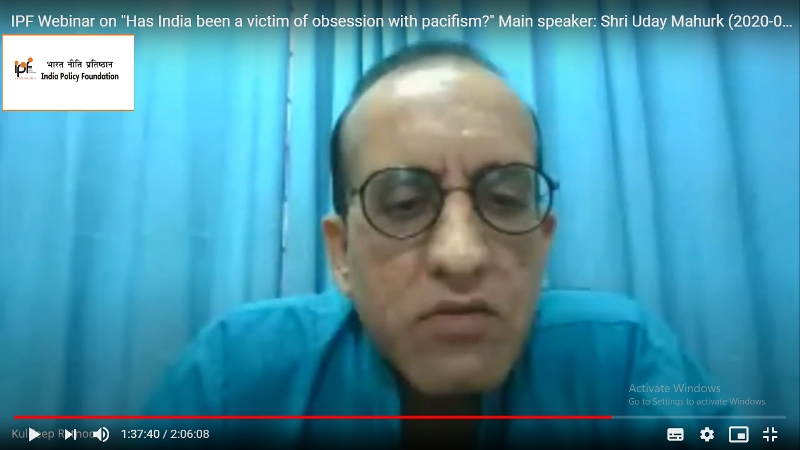
You mentioned about some incidents. We also remember the Kargil war in which our then Prime Minister Shri Vajpayee proudly assured the world that Pakistani army personnel had intruded into Indian Territory and we would force them to return to their territory but Indian armed forces won’t enter into Pakistan’s territory. They intruded into India, captured our heights and army posts, they killed our soldiers, yet we took pride in telling the world that Indian government didn’t allow its Army and Air force to enter into Pakistan’s territory even while chasing the intruders.
Now, China is a bigger and powerful country, but we have repeatedly failed to respond appropriately to aggression and instigations from much smaller countries. In this background, how long India will remain safe and secure?
Question and Answer session
The lecture was followed by a lively interaction with the audience in which many points were discussed.
ShriMahurkar stressed that the time has come for a gear shift where we need to get out of the mindset that we can’t criticize Gandhi. He said in ShaheenBagh the fact that the first photo is of Gandhi exposed the damage that pacifism has done to our nation. He recollected Savarkar’s words and said what is happening at present is “perversion of virtues.”
To a question whether the policy of non-alignment was bad, he said non-alignment is good as long as it is used in the context of Chanakya Niti.
Moving on, he pointed out that Shivaji’s model and Savarkar’s model is the same as Shivaji is the first ruler who said “attack is the best form of defence.”
He added that India has failed to respect its heroes and have many times eulogized its invaders. He pointed out that Gandhi had termedRanaPratap Singh, Shivaji and Guru Gobind Singh as “misguided patriots.”
Answering a question related to fundamentalism, he said in the last six years, almost 10,000 scholars have come to India to teach puritanical Islam to the Muslim population. The more they come, the more Muslims will get denationalized. However, he stressed that India will have to make space for moderate Muslims. He pointed out that the government would not have been able to do what it did without the help of Muslims.
On another question on the spread of minorityism, he said. “A Hindu nation will not allow the creation of a nation within the nation in the name of minorityism. This has been construed as Muslims been denied their rights in India. We have been unable to break this narrative due to Gandhian pacifism.”
He added that the Muslim population in India has risen by 600 per cent in the last 74 years. And the actual figures may be much more, because we don’t get actual data.
To a question whether there has been a lack of proactive approach and lack of risk taking attitude, Mahurkar disagreed and said that pacifism was the main reason for all that was happening in India at present. He said, to understand this, views of Savarkarshould be read seeing the rise of pan Islamist movements. He opined that there had always been a conspiracy to defame Savarkar.
He recollected an incident when a reporter asked Savarkar why was he and Jinnah calling for the break-up of India, Savarkar had then said that while Jinnah wants more and more rights for the Muslims at the cost of the rights of Hindus, I am fighting for equal rights to all.
Mahurkar agreed that Savarkar had written few mercy petitions and Shivaji had also written few mercy petitions to Aurangazeb. But what is ignored is that it was a tactful move by a revolutionary to escape from prison. Savarkar had said this in his book too. Savarkar also encouraged the other revolutionaries to do the same and restart the revolutionary movement.
Mahurkar opined that Savarkar was a visionary and was the father of India’s national security.
Another point that he made during the discussion was the need to reform India’s education system. Giving an example, he said, Syed Ahmed Khan is the person who laid the foundation of the two-nation theory. But there is falsification of history which remembers him only for his role in founding Aligarh Muslim University. There is a need to reform the primary education system to celebrate the unsung heroes of the nation. He suggested that a campaign should be launched to spread awareness.
(Report prepared by Lekshmi Parameswaran. Inputs by Vikrant Tyagi)